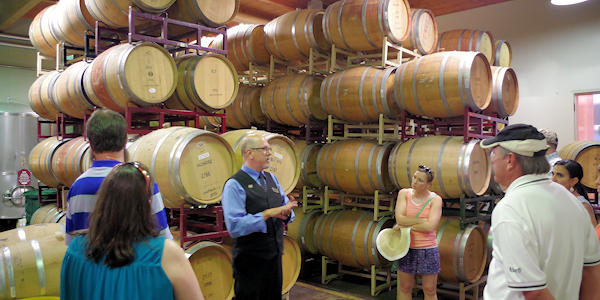
Learn how wine is made during your self-guided tour of the Biltmore Winery, included in your admission ticket to Biltmore. Start with an introductory film. Take a look at the fermentation room and corking area. Wander through the cool cellars where wines age.
Tasting Room
Visit the tasting room and enjoy complimentary samples of Biltmore's award-winning wines. Guests must be at least 21 years of age to taste wine. Please be prepared to show your ID. Children are welcome to participate with grape juice.
Wine Shop
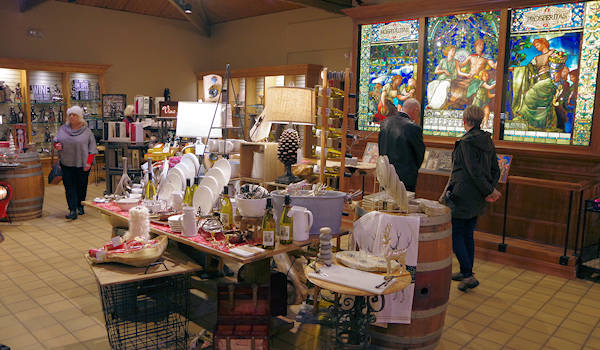
Explore the Wine Shop with its excellent selection of Biltmore wines, glasses, wine-related items, cooking accessories, and gourmet foods.
Wine Bar
Open Daily, 1:30 p.m.–7:00 p.m.
Relax with a glass of your favorite Biltmore wine. Light fare offered. Live music on Friday, Saturday, and Sunday afternoons.
Special Happenings
There's always something special going on at the winery. Year-round activities include barrel tastings, food and wine pairing, and cooking demonstrations. On special event weekends, jazz and blues bands perform, and children of all ages can try stomping grapes.
Wine Tasting Tips
- Feel free to ask your host questions about the wines and wine tasting.
- Wine tasting is a social activity, so feel free to talk about what you see, smell, and taste.
- Notice the clarity of good wines as you hold them to the light.
- Place your nose at the rim of the glass and inhale deeply to catch the wine's "bouquet."
- Hold the wine on your tongue a few seconds; then whistle in to take advantage of additional flavors released by exposure to the air.
- Notice the more full-bodied taste of red wines and the aftertaste that lingers in your mouth, a sure sign of a good wine.
- Most of all, have fun!
More About the Winery
The most visited winery in the United States isnt located in Napa Valley. Its at Biltmore Estate in the Blue Ridge Mountains of North Carolina, where fine food and wine paired with elegant entertaining have been traditions since the turn of the 19th century.
After George W. Vanderbilt opened Biltmore Estate to friends and family in the 1890s, the property and the mountains around Asheville, NC, became a favorite destination for many of his well-traveled cousins, aunts and uncles. For many of his sophisticated New York relations, the trip undoubtedly afforded the unique opportunity to dine on fresh vegetables, meats and Biltmore dairy products produced on the estate.
Todays guests, in addition to enjoying many of the same entertainments the Vanderbilts did, also have the opportunity to taste Biltmore Estates own award-winning wines, produced and bottled on the property in a 90,000 square foot, state-of-the-art winery. The facility, which opened in 1985 to guests, is housed in a converted dairy barn, originally designed by the firm of Richard Morris Hunt, the architect for Biltmore House. It features as
its architectural centerpiece, the buildings original clock tower.
With more than 900,000 annual guests from around the world, Biltmore Estate strives to accommodate those who are new to the world of wine and food as well as the connoisseur in search of a distinctive varietal. Biltmore Estate Winery offers guests the opportunity to view fermentation and bottling rooms, stroll through the cellars, enjoy special food and wine events and, of course, taste the finished product.
Biltmores wines are produced under three labels: George Washington Vanderbilt, the Estates premium vintages; Biltmore Estate Chateau Reserve, fine quality varietal wines; and Biltmore Estate, premium table wines which are both blended and varietals. Biltmore Estate wines have taken more than 300 medals in both national and international wine competitions, including a double gold, and numerous gold medals at such prestigious contests, as the San Francisco International Wine Competition and The Dallas Morning News National Wine Competition.
Red wines produced on Biltmore Estate include Merlot, Cabernet Sauvignon, Cabernet Franc, Vanderbilt Claret, Syrah, Pinot Noir and Cardinals Crest. White wines include Chardonnay, Chenin Blanc, Riesling, Pinot Gris and Sauvignon Blanc. Roses offered include Zinfandel Blanc de Noir and Cabernet Sauvignon Blanc de Noir. Sparkling wines produced in the methode champenoise are also made. A special Chardonnay Sur Lies, a favorite French wine that is rarely produced in the United States, is another choice selection at Biltmore Estate.
But these medal-winning results didnt happen overnight. The first vineyards at Biltmore Estate were established in 1971 in an area below Biltmore House. French-American hybrids were planted initially, with vinifera plantings following in a few years.
After several years of experimenting, William A.V. Cecil, president and owner of Biltmore Estate, decided that a winery was the natural outcome of ongoing research and a logical extension of his grandfathers intention that the estate be self-supporting.
Cecils grandfather, George W. Vanderbilt, was the man who conceived and created Biltmore Estate, with its 250-room French Renaissance chateau, extensively landscaped gardens and original 125,000 acres of land. Built between 1890 and 1895, Biltmore House is a National Historic Landmark and the largest privately owned home in America. Operating on a profitable basis with no governmental assistance, Biltmore Estate is indeed self-sufficient.
When vineyard experiments indicated a wine operation was feasible, Cecil did just as his grandfather would have donesought the best possible help available. He traveled to France and hired a veteran winemaker as a consultant to help get his new enterprise going.
Selected for the job was Philippe Jourdain of Provence, a winemaker of the European school who, as a sixth generation winemaster, had been involved in the winemaking business all his life. Not only had Jourdain operated a family vineyard, but also was a respected teacher of viticulture and oenology, having taught at the Lycee Agricole in Carcassone.
In 1979, two years after Jourdain began working with the estate, Biltmore sold its first bottle of wine. Pleased with the results, Cecil convinced Jourdain to become the estates first official winemaker. Under Jourdains guidance, Biltmore began the serious cultivation of vinifera grapes, the finer quality European varietals, and began phasing out the French- American hybrids it previously depended upon. The original hybrids have since been replaced
entirely with the European varietals.
Although the hybrids have a greater yieldaveraging six tons of grapes to the acreCecil wanted a better quality wine than the hybrids offered. Making the switch was not without its challenges, however, and it took the combined talents of Jourdain, Winemaker Bernard Delille and vineyard staff to cultivate the sensitive vinifera in the unique climate and soils of Western North Carolina.
When Jourdain retired in 1995, Delille was the best candidate to become Biltmores next winemaster. Having been winemaker at the Estate since 1986, Delille recognized the challenges and opportunities as Biltmore Estate Wine Company began its next phase of maturity.
The vineyard is located in a long valley area across the French Broad River from Biltmore House. A 35-acre lake constructed near these vineyards provides irrigation for frost controlan ever-present concern in the spring since frost occurs in the mountains as late as May 15. In fact, from April 15 to May 15, a time when the vines tender shoots are most vulnerable, the vineyard staff goes on frost duty to prevent any damage to the developing
grapes.
Biltmore Estate produces 100,000 cases of wine priced to compete with the quality California wines each year. They are available throughout the Southeast.
Biltmore Estate Wine Company, by national standards, is a medium size operation, said Cecil, who doesnt foresee the winery becoming a major wine producer. Our intention is to produce fine wines, not necessarily great quantities of wine, he said.
Bernard Delille, Winemaster
A native of France, Bernard Delille came to the United States in 1986 to join Biltmore Estate Wine Company as assistant winemaster. He rose to the position of winemaster and oversees production of all our wines.
Delille holds a Master's degree in biochemistry and certificates in microbiology and enology from the Faculty of Science in Lyon, France. He served his internship in the Bordeaux region of France and received his French National Diploma of Winemaker in Dijon, Burgundy. Prior to joining Biltmore Estate Wine Company, Delille was a winemaker in the Pyrenees Atlantiques region, where he made wines with regional appellations of Mandarin and Jurancon.
Sharon Fenchak, Winemaker
A native of Georgia, Sharon Fenchak has been with Biltmore since 1999. She works closely with Winemaster Bernard Delille to produce Biltmore's award-winning wines. In addition to wine production, Fenchak is involved with in-house research and development to help Biltmore lead the way in employing new grape-growing technology and testing grape-production methods.
Before joining Biltmore, Fenchak was Winemaker at Chestnut Mountain Winery in Braselton, GA, where she oversaw the wine development process. Prior to that, she was employed as Assistant Winemaker at Habersham Winery in Baldwin, GA. She holds a master's degree in food science from the University of Georgia and a bachelor's degree in food science from Penn State University.
|